
Southeast Asia Friendship Initiative (SFI) Course
Welcome to our Southeast Asia Friendship Initiative (SFI) FAQs page!
Past Year's Highlight:
SFI 2025
Southeast Asia Friendship Initiative Trip 2025
Learning Beyond the Classroom: Kent Ridge Hall’s Journey to Phuket, Thailand
In December 2025, 30 students from Kent Ridge Hall embarked on a ten-day experiential learning journey to Phuket, Thailand, as part of the Southeast Asia Friendship Initiative (SFI2034). Designed to move learning beyond the classroom, this programme immersed students in real-world challenges faced by communities in Phuket and encouraged them to respond using an entrepreneurial and problem-solving mindset. Through site visits, stakeholder engagement, and cultural exchanges, students explored how the United Nation Sustainable Development Goals (SDGs) manifest on the ground — where environmental, economic, and social priorities intersect in complex ways.
Understanding Sustainability on the Ground
Rather than studying sustainability in abstraction, students encountered it through lived experiences across Phuket. At the Sustainable Tourism Development Foundation, they examined how mass tourism contributes to carbon emissions and environmental strain, and discussed what it would take to move Phuket towards carbon-neutral tourism. This was further reinforced at the Phuket Solid Waste Management Centre at Saphan Hin Park, where students traced how tourism-generated waste is processed — and where existing systems fall short.
One of the students, Khen Nipanuthiyan, mentioned that “ Seeing how waste is actually handled on the ground really changed [his] perspective about [his] consumption as a tourist. Sustainability issues also extended to ecosystems and food systems.” Visits to the Marine Conservation Research Centre highlighted the threats facing marine biodiversity due to pollution, irresponsible tourism, and overfishing, while showcasing rescue and rehabilitation efforts. Together, these experiences made clear that sustainability challenges in Phuket are interconnected, spanning climate action, responsible consumption, marine conservation, and sustainable cities.
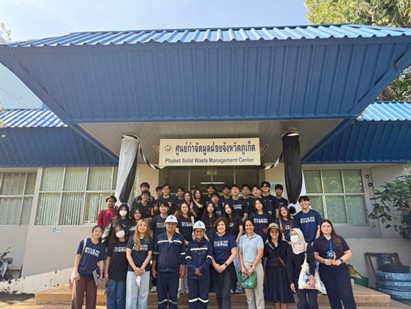
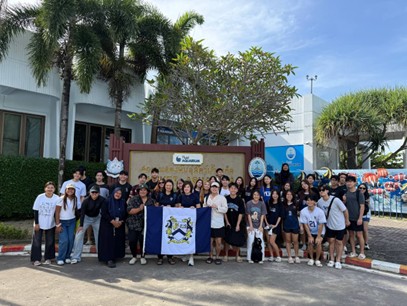
Figure 1 & 2: Students visiting Phuket Solid Waste Management Centre & the Marine Conservation Centre’s Aquarium and Animal Hospital respectively.
Entrepreneurship as a Tool for Impact
Entrepreneurship emerged as a key lens through which students were encouraged to engage with these challenges. At Ker Chor Elephant Family Phuket, students explored how ethical wildlife tourism can be economically viable while prioritising animal welfare. By comparing ethical sanctuaries with exploitative elephant tourism models, students were prompted to think critically about how education, partnerships, and innovative business models could strengthen responsible tourism practices.
Similarly, visits to the Black Salmon Aquaculture Farm and the Koh Siray Sea Gypsy Community pushed students to examine how food security, livelihoods, and environmental sustainability can be balanced. Students analysed how aquaculture, traditional fishing, and tourism demand interact —and how entrepreneurial solutions could respect cultural heritage while supporting sustainable marine practices. These case studies reframed SDG challenges as opportunities for social innovation, rather than problems with one-size-fits-all solutions. SFI participant Justin Goh added that “There’s no perfect solution – but understanding different stakeholders opened my team and I up to six to seven solutions that are fairer and more realistic.”
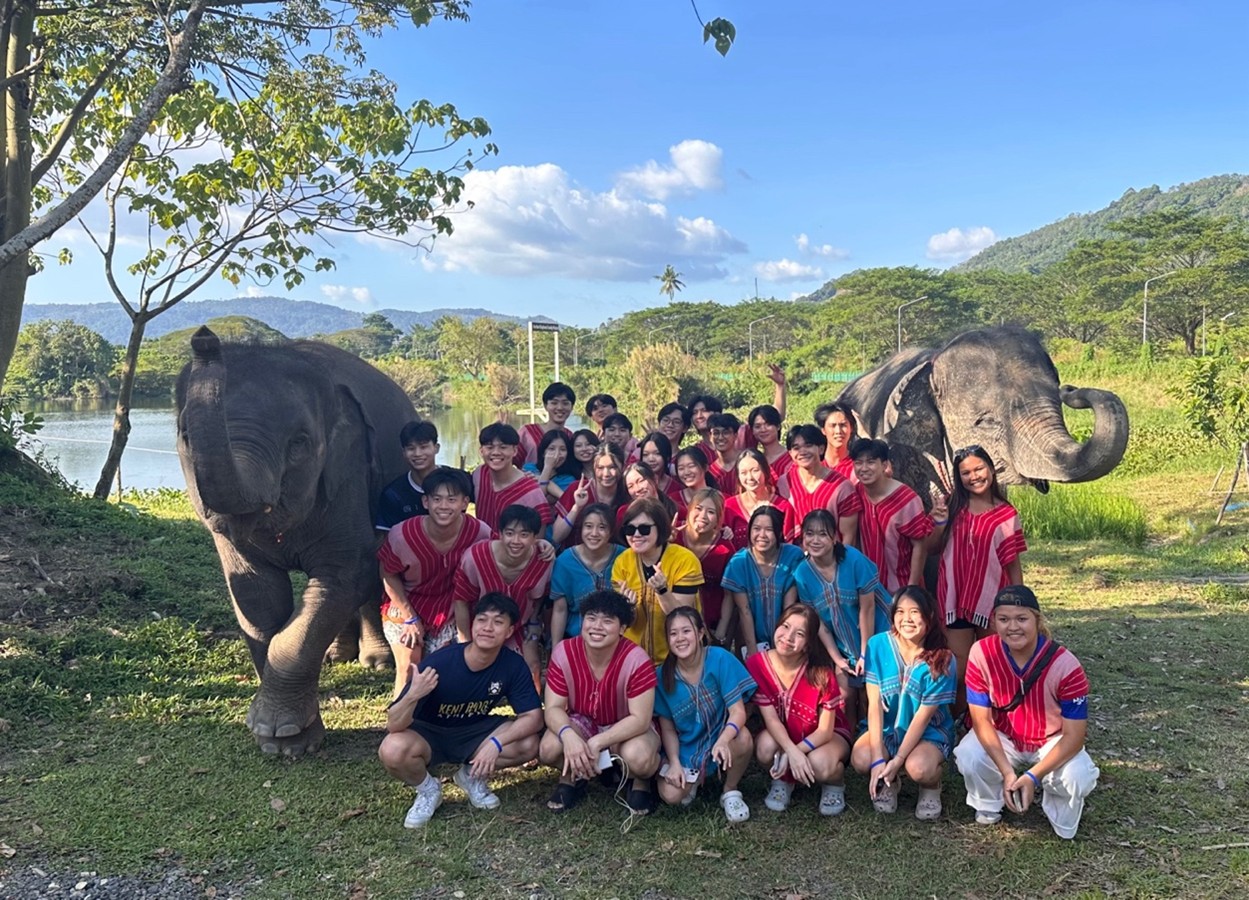
Figure 3: Students engaging with the baby elephants at Ker Chor Elephant Sanctuary
Cultural Immersion Beyond Observation
Cultural immersion was not treated as a side activity, but as a core component of learning. Through engagement with the Sea Gypsy Community, students gained insight into indigenous maritime culture and how identity, tradition, and livelihood are deeply intertwined. Visits to traditional markets further revealed how small-scale businesses sustain local economies and reinforce community ties.
At the Thai Traditional Medicine Service Centre at Prince Songkla University, students explored how traditional Thai medicine supports holistic well-being, addressing physical health, mental balance, and stress relief. These experiences challenged assumptions shaped by Western healthcare models and highlighted how cultural knowledge can complement modern systems. Learning basic Thai expressions and navigating daily interactions also fostered cross-cultural intelligence, reminding students that sustainable development must be culturally grounded.
A Lasting Perspective Shift
By the end of the journey, students returned with more than memories — they gained a shift in perspective. Sustainability was no longer a distant global agenda, and entrepreneurship was no longer solely about profit. Instead, students saw how ethical decision-making, cultural sensitivity, and community engagement are essential to creating lasting impact.
The Phuket experience demonstrated that meaningful solutions require listening before innovating, and understanding before acting. Through real-world exposure, collaborative problem-solving, and cultural immersion, students began to see themselves not just as learners, but as future changemakers capable of shaping sustainable futures in Southeast Asia and beyond. 4th year graduating student Kang Ying Xuan reflected on the trip, stating that “This trip reminded [her] that real impact starts with humility – listening first, then acting with intention.”
SFI 2024
Frequently Asked Questions:
What is the Southeast Asia (SEA) Friendship Initiative (SFI)?
Southeast Asia (SEA) Friendship Initiative (SFI) officially launched in May 2023 since AY2022/23 Special Term Part 1.
Designed for undergraduate (UG) students in residential units to read a credit-bearing course introducing them to a SEA country, complemented by a study trip to the targeted country with experiential learning in mind focusing on the UN 17 Sustainable Development Goals (SGD) theme and/or Innovation and Enterprise.
This initiative is being organized by 12 Residential Units, i.e., 6 Halls, 2 Houses and 4 Residential Colleges in collaboration with the Global Relations Office and Provost's Office, with Southeast Asian Studies and Malay Studies Departments as academic hosts for SFI courses being offered to Halls and Houses.
What is SFI2034 course?
Kent Ridge Hall provides KR Hall residents the opportunity to take the SFI Course, which is a 4 credit-bearing course with experiential learning components that includes an overseas study trip.
Who is eligible and can sign up for this SFI2034 course?
All UG students living in Kent Ridge Hall being enrolled in full-time UG degree programmes i.e., local (Singapore citizen, Singapore Permanent Resident holder) and international students, who are paying tuition fees to NUS can apply to read SFI course only once during their candidature. This course is not applicable to non-graduate/exchange students.
What does SFI2034 course consist of?
- Lectures (3 x 2 hours): Lectures are scheduled to occur during the weeks of 1, 2, and 9.
- Tutorials (2 x 2 hours): Tutorials are planned for the weeks of 3 and 10.
- Language Classes (5 x 2 hours): Language classes are scheduled for the weeks of 4 to 8.
- Participants will be introduced to the country covering relevant aspects in history, population, government, politics and society, economy and heritage.
- Overseas study trip (see below for more information)
When will the course be conducted?
When: Offered in Sem 2. Tentative dates: 6 - 15 Dec 2026
Where: Thailand (to be confirmed)
Are the lectures and tutorials mandatory?
Yes, attendance for both lectures and tutorials is mandatory, as they are designed to enhance participants' learning experience and contribute to their overall assessment.
What are the key Learning Outcomes from the SFI2034 course?
- Gain global and intercultural intelligence to appreciate the social and working norms in the specific SEA country.
- Deepen their knowledge of the key development goals SDG(s), or Innovation & Enterprise in the target country/countries.
- Learn about the significant local challenges to achieving specific SDGs, and what local solutions are being used by these communities.
- Understand the intricacies of collaborations between Singapore and the country against the larger socio-economic backdrop of the region.
- Expand the student's social and professional networks to aid their future career prospects in the region.
What is the key difference between a regular course and the SFI2034 course?
- Component of study trip and its focus of experiential learning whereby students are expected to apply and promote critical thinking through engagement with important sites, and two-way dialogues with representatives from universities, well-established organizations and community partners related to targeted SDGs or social enterprise, and government offices, in understanding and empathizing with the issues that are important to the community.
- Students apply what they learn in classes to out of class through immersion learning, and real-life experiences.
How much does a participant need to pay for the trip?
The study trip is heavily subsidized by the University, hence as part of students' commitments to the trip, there will be a co-payment required by each student (between $300 to $500 per student).
The co-payment fee will cover air fare, ground transport, overseas accommodation, cultural activities and most meals.
Overseas Study Trip
How will the course be assessed?
- Academic assessment: 50% to be graded by academic Faculty.
- The 50% component may comprise of class participation, Group Project, Post-trip Group project, quizzes/ test and others. - Experiential learning assessment : 50% to be graded by Kent Ridge Hall SFI Coordinator/RF-in-charge
- The other 50% component will be based on Immersion visit assessment (which may include group presentations and individual reflections).
Please note that the above may be subject to changes.
Is this course CS/CU or letter-graded?
- All SFI courses offered are major-coded and credit-bearing. Students can read to full major or unrestricted elective (UE) requirement, and letter-graded on students' transcripts.
- Students may exercise the satisfactory/unsatisfactory (S/U) option with the understanding that they are Malay Studies/SEA major students, and on the assumption that they have yet to exercise the S/U option for up to 32 Units for courses.
Any other questions?
Please email RF-in-charge, Ms. Claire Cheong